
Análisis morfogenético de aislamientos de Cercospora kikuchii provenientes de distintas regiones de la Argentina
DOI:
https://doi.org/10.47230/agrosilvicultura.medioambiente.v4.n1.2026.4-20Palabras clave:
Tizón foliar, Patometría, Haplotipos, Variabilidad genéticaResumen
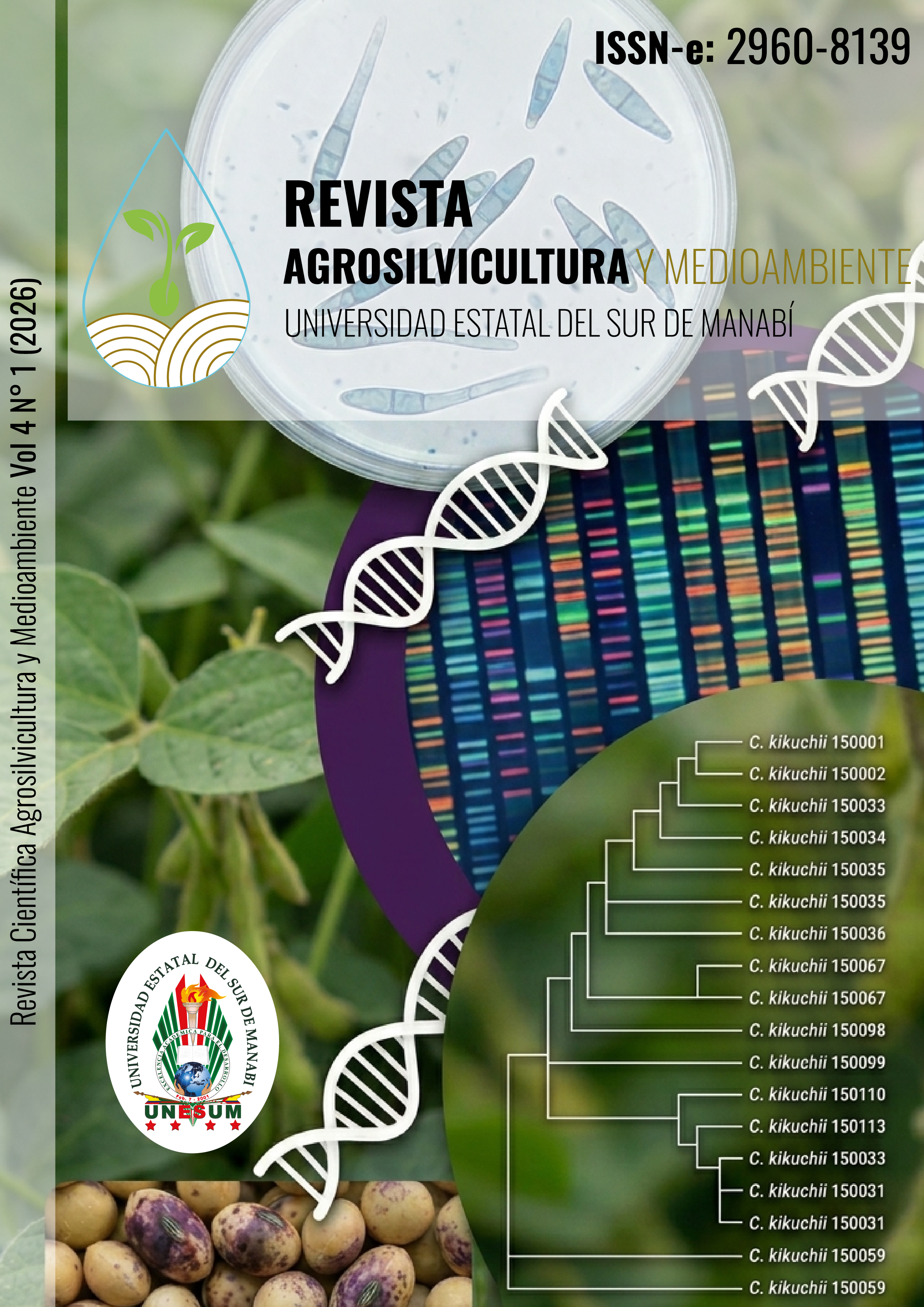
La caracterización morfológica y molecular de Cercospora kikuchii es necesaria para un mejor profundizar en el… conocimiento del patógeno en Argentina. Analizar morfológica y molecularmente los aislamientos de C. kikuchii recolectados de pecíolos y semillas durante los años 2015 y 2016 a través de las diferentes regiones sojeras de Argentina. Los análisis morfológicos de los 528 aislamientos y los moleculares de 96 aislamientos fueron realizados en los laboratorios de Biotecnología y Fitopatología, en Pergamino, Buenos Aires, Argentina durante 2015 a 2021. La caracterización morfológica tuvo en cuenta la región y el órgano de origen, el año y variables patométricas. La caracterización molecular se realizó con siete secuencias blanco-nucleares y una mitocondrial. La estructura genética de la población se examinó a través del software STRUCTURE y Análisis de Varianza Molecular (AMOVA). La relación longitud / ancho de los conidios fue mayor en los aislamientos provenientes de la región norte, comparada con las de las regiones pampa norte y pampa sur. El análisis morfogenético de los aislamientos indicó que pertenecen a la especie C. kikuchii. No se encontró estructuración en la población de C. kikuchii de Argentina. Los aislamientos de C. kikuchii mostraron variación morfológica y molecular sustancial, aunque no asociada con el órgano de origen: pecíolo y semilla. La información molecular indica que las variantes de haplotipos tenían una mayor homología con secuencias de C. kikuchii descritas previamente que con secuencias de otras especies. Tomados en conjunto, los datos demuestran que en Argentina el tizón foliar por Cercospora y la mancha púrpura de la semilla en soja, son dos enfermedades causadas por una única especie: C. kikuchii. En consecuencia, sugerimos un nuevo nombre para la enfermedad, el Síndrome Purpúreo en Soja o en inglés “Soybean Purple Syndrome”.
Descargas
Citas
Agrios, G. N. (2005). Plant pathology (5.ª ed.). Academic Press.
Albertini, C., Gredt, M., & Leroux, P. (1999). Mutations of the β-Tubulin gene associated with different phenotypes of benzimidazole resistance in the cereal eyespot fungi Tapesia yallundae and Tapesia acuformis. Pesticide Biochemistry and Physiology, 64(1), 17-31. https://doi.org/10.1006/pest.1999.2406
Albu, S., Schneider, R. W., Price, P. P., & Doyle, V. P. (2016). Cercospora cf. flagellaris and Cercospora cf. sigesbeckiae are associated with Cercospora leaf blight and purple seed stain on soybean in North America. Phytopathology, 106(11), 1376-1385. https://doi.org/10.1094/PHYTO-12-15-0332-R
Albu, S., Sharma, S., Bluhm, B. H., Price, P. P., Schneider, R. W. & Doyle, V. P. (2017). Draft genome sequence of Cercospora cf. sigesbeckiae, a causal agent of Cercospora leaf blight on soybean. American Society for Microbiology Journals 5: 36. https://doi.org/10.1128/genomea.00708-17
Balzarini, M. G., & Di Rienzo, J. A. (2016). InfoGen (Versión 2016) [Software]. Universidad Nacional de Córdoba. http://www.info-gen.com.ar
Cai, G., & Schneider, R. W. (2005). Vegetative compatibility groups in Cercospora kikuchii, the causal agent of Cercospora leaf blight and purple seed stain in soybean. Phytopathology, 95(3), 257-261. https://doi.org/10.1094/phyto-95-0257
Carbone, I., & Kohn, L. M. (1999). A method for designing primer sets for speciation studies in filamentous ascomycetes. Mycologia, 91(3), Article 553. https://doi.org/10.1080/00275514.1999.12061051
Crous, P., Braun, U., & Groenewald, J. (2007). Mycosphaerella is polyphyletic. Studies In Mycology, 58(1), 1-32. https://doi.org/10.3114/sim.2007.58.01
Crous, P. W., Groenewald, J. Z., Risède, J., Simoneau, P., & Hywel-Jones, N. L. (2003). Calonectria species and their Cylindrocladium anamorphs: species with sphaeropedunculate vesicles. Studies in Mycology, 50, 415-430. https://doi.org/10.3114/sim.55.1.213
Di-Rienzo, J. A., Casanoves, F., Balzarini, M. G., González, L., Tablada, M., & Robledo, C. W. (2011). InfoStat. Grupo InfoStat. http://www.infostat.com.ar
Earl, D. A., & vonHoldt, B. M. (2011). STRUCTURE HARVESTER: a website and program for visualizing STRUCTURE output and implementing the Evanno method. Conservation Genetics Resources, 4(2), 359-361. https://doi.org/10.1007/s12686-011-9548-7
Elvin, M., Loros, J. J., Dunlap, J. C., & Heintzen, C. (2005). The PAS/LOV protein VIVID supports a rapidly dampened daytime oscillator that facilitates entrainment of the Neurospora circadian clock. Genes & Development, 19(21), 2593-2605. https://doi.org/10.1101/gad.349305
Evanno, G., Regnaut, S., & Goudet, J. (2005). Detecting the number of clusters of individuals using the software structure: a simulation study. Molecular Ecology, 14(8), 2611-2620. https://doi.org/10.1111/j.1365-294x.2005.02553.x
Excoffier, L., Smouse, P. & Quattro, J. (1992). Analysis of molecular variance inferred from getric distances among DNA haplotypes: application to human mitochondrial DNA restriction data. Genetics, 131, 479-491
Goodwin, S. B., Dunkle, L. D., & Zismann, V. L. (2001). Phylogenetic analysis of Cercospora and Mycosphaerella based on the internal transcribed spacer region of ribosomal DNA. Phytopathology, 91(7), 648-658. https://doi.org/10.1094/phyto.2001.91.7.648
Gower, J. C. & Ross, P. G. N. (1969). Minimum spanning tress and single cluster analysis. Applied Statistics, 18, 54-64
Groenewald, J., Nakashima, C., Nishikawa, J., Shin, H. D., Park, J. H., Jama, A., Groenewald, M., Braun, U., & Crous, P. (2013). Species concepts in Cercospora: spotting the weeds among the roses. Studies in Mycology, 75, 115-170. https://doi.org/10.3114/sim0012
Hall, T. A. (1998). BIOEDIT: A user-friendly biological sequence alignment editor and analysis program for windows 95/98/ nt. Nucleic Acids Symposium Series, 41(2), 95-98. https://www.academia.edu/2034992/BioEdit_a_user_friendly_biological_sequence_alignment_editor_and_analysis_program_for_Windows_95_98_NT
Hubisz, M. J., Falush, D., Stephens, M., & Pritchard, J. K. (2009). Inferring weak population structure with the assistance of sample group information. Molecular Ecology Resources, 9(5), 1322-1332. https://doi.org/10.1111/j.1755-0998.2009.02591.x
Imazaki, I., Iizumi, H., Ishikawa, K., Sasahara, M., Yasuda, N., & Koizumi, S. (2006). Effects of thiophanate-methyl and azoxystrobin on the composition of Cercospora kikuchii populations with thiophanate-methyl-resistant strains. Journal of General Plant Pathology, 72(5), 292-300. https://doi.org/10.1007/s10327-006-0285-9
Jakobsson, M. & Rosenberg, N. A. (2007). CLUMPP: a cluster matching and permutation program for dealing with label switching and multimodality in analysis of population structure. Bioinformatics, 23(14), 1801-1806. https://doi.org/10.1093/bioinformatics/btm233
Jenns, A. E. (1989). Regulation of Cercosporin Accumulation in Culture by Medium and Temperature Manipulation. Phytopathology, 79(2), Article 213. https://doi.org/10.1094/phyto-79-213
Johnson, M., Zaretskaya, I., Raytselis, Y., Merezhuk, Y., McGinnis, S., & Madden, T. L. (2008). NCBI BLAST: a better web interface. Nucleic Acids Research, 36(Suppl. 2), W5-W9. https://doi.org/10.1093/nar/gkn201
Lavilla, M., Ivancovich, A., & Díaz Paleo, A. (2021). Evaluación del tizón foliar y la mancha púrpura en semilla de soja en Argentina. Agronomía Mesoamericana, 32(2), 619-628. https://doi.org/10.15517/am.v32i2.43359
Lavilla, M., Ivancovich, A., & Díaz-Paleo, A. (2022). Tizón Foliar y la Mancha Púrpura de la semilla causados por Cercospora kikuchii en soja (Glycine max L. Merr.). Agronomía Mesoamericana, 33(3), Artículo 48494. https://doi.org/10.15517/am.v33i3.48494
Lavilla, M. A., Ivancovich, A., & Martínez, M. (2022). Relación entre la cosecha demorada de soja y la presencia de patógenos en las semillas y en los rastrojos. Agriscientia, 39(1), 153–159. https://doi.org/10.31047/1668.298x.v39.n1.20462
Librado, P., & Rozas, J. (2009). DnaSP v5: a software for comprehensive analysis of DNA polymorphism data. Bioinformatics, 25(11), 1451-1452. https://doi.org/10.1093/bioinformatics/btp187
Liu, D., Coloe, S., Baird, R., & Pedersen, J. (2000). Rapid Mini-Preparation of Fungal DNA for PCR. Journal of Clinical Microbiology, 38(1), 471-471. https://doi.org/10.1128/jcm.38.1.471-471.2000
Nei, M. (1989). Molecular evolutionary genetics. Columbia University Press.
Pritchard, J. K., Stephens, M., & Donnelly, P. (2000). Inference of population structure using multilocus genotype data. Genetics, 155(2), 945-959. https://doi.org/10.1093/genetics/155.2.945
Sautua, F. J., Gonzalez, S. A., Doyle, V. P., Berretta, M. F., Gordó, M., Scandiani, M. M., Rivarola, M. L., Fernandez, P., & Carmona, M. A. (2019). Draft genome sequence data of Cercospora kikuchii, a causal agent of Cercospora leaf blight and purple seed stain of soybeans. Data in Brief, 27, Article 104693. https://doi.org/10.1016/j.dib.2019.104693
Soares, A. P. G., Guillin, E. A., Borges, L. L., Silva, A. C. T. D., Almeida, L. M. R. D., Grijalba, P. E., Gottlieb, A. M., Bluhm, B. H., & Oliveira, L. O. D. (2015). More Cercospora species infect soybeans across the Americas than meets the eye. PLoS ONE, 10(8), Article e0133495. https://doi.org/10.1371/journal.pone.0133495
Sokal, R. R., & Michener, C. D. (1958). A statistical method for evaluating systematic relationships. University of Kansas Science Bulletin, 38(6), 1409-1438. http://en.journals.sid.ir/ViewPaper.aspx?ID=146268
StatSoft. (2005). STATISTICA Data analysis software system. https://statistica-update.software.informer.com/7.1/
Stewart, J. E., Timmer, L. W., Lawrence, C. B., Pryor, B. M., & Peever, T. L. (2014). Discord between morphological and phylogenetic species boundaries: incomplete lineage sorting and recombination results in fuzzy species boundaries in an asexual fungal pathogen. BMC Evolutionary Biology, 14(1), Article 38. https://doi.org/10.1186/1471-2148-14-38
Thompson, J. D., Higgins, D. G., & Gibson, T. J. (1994). CLUSTAL W: improving the sensitivity of progressive multiple sequence alignment through sequence weighting, position-specific gap penalties and weight matrix choice. Nucleic Acids Research, 22, 4673-4680. https://doi.org/10.1093/nar/22.22.4673
White, T., Bruns, T., Lee, S., & Taylor, J. (1990). Amplification and direct sequencing of fungal ribosomal RNA genes for phylogenetics. PCR Protocols. Academic Press. https://doi.org/10.1016/b978-0-12-372180-8.50042-1
Descargas
Publicado
Cómo citar
Número
Sección
Licencia
Derechos de autor 2026 Miguel Lavilla

Esta obra está bajo una licencia internacional Creative Commons Atribución 4.0.